

Technical Bulletin 14(B) Edition 2 – Working within scope of work categories
Note: This version of Technical Bulletin (TB) 014 (B) Edition 2 replaces the version originally published 22 September 2025, which is now withdrawn. This version has been reviewed and where appropriate revised to update references to ensure it remains current and relevant.
This TB provides guidance to Gas Safe registered businesses/engineers on industry standards and competence requirements that apply to gas work activities in different environments, to ensure all gas work is carried out by competent engineers holding the correct work categories.
Introduction
The Gas Safety (Installation and Use) Regulations 1998 (GSIUR)(1) require persons undertaking gas work to be competent to carry out the work. The regulations place a duty on the person undertaking the work, their employer and any other business in control of the work to ensure competence. All businesses working within the scope of the GSIUR must be registered with the Gas Safe Register (GSR).
For guidance, please see the Gas Safety (Installation and Use) Regulations 1998 (GSIUR) as amended Approved Code of Practice and guidance (L56).
GSR’s rules of registration Section 2 states the following:
Anyone carrying out Gas Work must:
- a) be listed against the Registered Business as an engineer and hold the appropriate registration work categories for the work being carried out. They must have a recognised certificate of gas safety competence for registration in each work category;
- b) ensure all gas work done meets the requirements of the relevant Health & Safety enforcement agency, in accordance with the current gas safety legislation that is in force in the relevant Health & Safety agency’s jurisdiction i.e. Great Britain, Isle of Man, Northern Ireland, Guernsey, and Jersey;
- c) do so competently’
Gas Safe Registers’ Rules of Registration can be viewed here:
https://www.gassaferegister.co.uk/media/yhzbcpqu/rules-of-registration.pdf
Background
Gas Safe Register regularly receives enquiries to confirm if an engineer’s work categories cover them to work in different environments. For example, can a domestic engineer with CKR1 install a domestic cooker in a non-domestic location, such as a school.
This Technical Bulletin has been written to help clarify the gas work competency requirements for certain environments and provide a guide to determine if the environment in which an appliance is installed is representative of the appliance design and safe operation.
It is important that when an engineer is working in different environments than normal that they recognise that other regulations such the Health and Safety at Work etc Act 1974 (HWSA)(2) will apply as well as the GSIUR, all of which need to be complied with. By holding the correct competence/work categories to match the environment, the engineer will understand how other regulations may overlap GSIUR and how manufacturer’s instructions interact with applicable Standards.
For example, an engineer holding competence in domestic cookers (CKR1), performing gas work on a domestic cookers in a school food technology (home economics) room, should do this work in line with the manufacturer’s instructions, Statutory instruments and with due consideration of IGEM/UP/11 Edition 3 Gas Installations for Educational Establishments(3), and therefore the engineer would need to have proved competence in relevant non-domestic work categories.
It may also be necessary to ensure a manufacturer’s concession is in place to confirm that a domestic appliance is suitable for use in a non-domestic environment where it does not clearly state this in the original manufacturers’ literature, and likewise a non-domestic appliance is suitable to use in a domestic environment. A concession to manufacturer’s instructions request form can be found here:
This Technical Bulletin is in-line with current guidance offered from relevant Standards and ACS Matters of Gas Safety and may be subject to change. It will be updated periodically to reflect any industry changes and is not retrospective.
Below is a flow chart for an engineer to follow to confirm whether or not they hold the correct work categories to carry out gas work:
Risk Assessment: Installing, servicing and maintaining domestic gas appliances in different environments.
Use this flowchart to determine if the environment in which the domestic appliance is installed satisfies the domestic work category requirements.
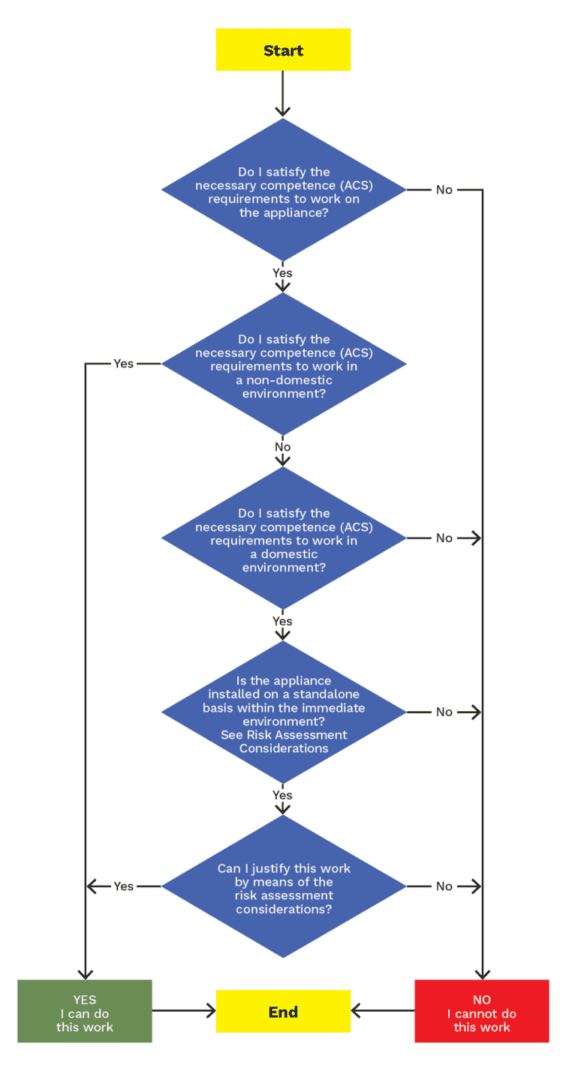
Risk assessment considerations
Do the installation instructions allow the appliance to be installed in the environment?
*Where an engineer is to install an appliance in an environment other than the type it is intended for, guidance must be sought from the manufacturer, and request for concession to manufacturers’ instructions form may be required.
Is the appliance installed on a stand-alone basis within the immediate environment?
(Eg, not part of an installation incorporating other appliances such as a modular boiler system, a boiler in a plant room or a domestic cooker in a commercial catering environment with other catering appliances etc.)
This does not include a domestic room sealed appliance installed in a catering environment
Is the gas installation downstream of an isolation valve within the scope of the current IGEM/UP/1B Tightness testing and direct purging of small Liquified Petroleum Gas/Air, Natural Gas and Liquified Petroleum Gas installations4 ?
(Only applicable if it is necessary to interrupt the gas supply to the whole installation).
These risk assessment considerations are not exhaustive and other variables may need to be taken into account.