

Updated tightness testing standard: what you need to know
An overview of the changes made to IGEM/UP/1B Edition 4 – and FAQs questions about the updated standard.
In March 2026, IGEM/UP/1B Edition 4(1) was published to replace the outgoing Edition 3. Unusually, both standards will be live for a period of 6 months to allow Gas Safe registered businesses time to get up to speed with the changes. Edition 3 will be withdrawn on 30 September 2026.
During this period, either tightness testing procedure may be used, although businesses are encouraged to adopt the new version as soon as practicable. From 1 October 2026, all tightness testing must be carried out in accordance with the new Edition 4.
While most of the standard remains unchanged (with the actual practice of how to carry out a tightness test remaining the same), those changes that have been made are significant. This article outlines the new tightness test procedure.
The procedure
Carry out a let-by of the Emergency Control Valve at 7-10 mbar for 1 minute. Once you are satisfied with the let-by test, you raise the pressure on the gauge to the correct tightness test pressure for the fuel gas.
This is where the first change is made to the new standard, which is the inclusion of a new note regarding tightness test pressures. This new note states that where the minimum tightness test pressure for the fuel gas cannot be achieved, the installation will need to be isolated, and investigations undertaken into the cause of the low pressure before proceeding with the test.
For natural gas, if 20 mbar cannot be achieved, the tightness test can be done at a minimum pressure of 18 mbar. Where the test is successful, operating pressure checks are to be carried out, as detailed in IGEM/G/13(2).
Where test pressures can be achieved, you should then allow 1 minute stabilisation, with a further 2 minutes’ test duration at the relevant test pressure for the fuel gas. If there is no movement of the gauge, the test passes – provided there has been no reported smell of gas. However, where there is any perceptible movement of the gauge, permissible limits for these drops are now decided by the installation volume (IV) of the system (or the part of the system being tested), rather than meter size and so you will need to calculate the IV of the system.
Once the IV has been calculated, the results shall be compared to the relevant table for the fuel gas to ensure the drop is within permissible limits. These permissible limits are as follows:
Table 2 gives the maximum permissible limits for LPG/air installations, which are:

Table 3 gives the permissible limits for movement on a natural gas installation:
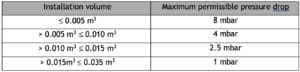
Table 5 gives the permissible limits for LPG installations (this remains unchanged from previous versions):
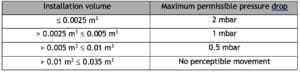
These permissible limits are only acceptable where there are existing appliances connected and no smell of gas has been reported. When testing pipework only or where only new appliances are connected, there can be no perceptible movement of the gauge.
Example
For example, if testing a natural gas installation with existing appliances connected, any drop over 1 mbar will require the IV of the system to be calculated and compared to Table 3 (if below 1 mbar, this will automatically be within permissible limits). Again, there can be no reported smell of gas for permissible limits to apply. If the drop is outside permissible limits, the escape must be traced and repaired, or the installation made safe.
If there has been any perceptible movement on the gauge, once it has been confirmed that any movement is within permissible limits, it must be established that the drop is not attributable to the installation pipework (including when it was not necessary to calculate the IV due to the movement being below the minimum permissible limit). Therefore, all appliances are now to be isolated and the test repeated on pipework only.
There can be no perceptible movement during this test. Where it is not practicable or possible to isolate an appliance, the test shall be done with that appliance connected and the “no perceptible movement criteria” applied. Where perceptible movement is again present, the escape must be traced and repaired, or the installation made safe.
Once a successful test has been completed, the manometer can be removed, the test nipple replaced, all isolated appliances re-introduced, and the gas supply turned on. All disturbed joints shall then be tested with leak detection fluid (LDF). Where appliances have been isolated, any installation pipework between an isolation valve and the appliance itself (for instance, pipework between an isolation valve and a gas hob) will also need to be tested with LDF. Where this is not practicable, then the appliance shall be left connected when testing pipework only.
Purging procedure
There has also been a minor change to the procedure for calculating the purge volume (PV). Where previously for installations with a maximum pipe size of 28mm and a meter not exceeding 6m3/hr you could assume a PV of 0.01m3, you must now work out the IV of all installations and multiply this by 1.5 to get the PV.
The purge procedures remain the same: for natural gas, purge to air for up to 0.02m3 and purge to ignition for any PV over 0.02m3. All LPG and LPG/air installations shall be purged to ignition.
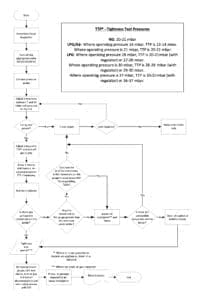
IGEM/UP/1B Edition 4: tightness test procedure overview
Frequently asked questions
Q. I have traced a drop in pressure to an appliance: do I need to disconnect it?
A. Not necessarily. Permissible limits are there for this scenario because small amount of gas may escape through some gas appliances. As long as there is no smell of gas from the appliance, the permissible limits allow the appliance to remain connected, as long as a suitable site-specific risk assessment deems it satisfactory to do so.
Q. Why do we now need to isolate appliances if there is a drop in pressure?
A. It has always been the case that there can be no perceptible movement when testing pipework only. Where a drop was detected during a tightness test on an installation containing existing gas appliances, it was not previously a requirement to confirm whether this was on pipework. During the review of the standard, it was requested to amend this so that where a drop in pressure is detected, you must now ensure that this is not attributable to installation pipework.
Q. I have two appliances in an installation. With both connected, the drop in pressure is over permissible limits. If I disconnect one of the appliances, this brings the drop within permissible limits. Is this acceptable?
A. As long as you have confirmed that the drop is not attributed to installation pipework, and there is no smell of gas recorded, this is acceptable. You must follow the guidance given in IGEM/G/11 (the Gas industry unsafe situations procedure) for the other appliance.
Q. The installation pipework disappears into the wall behind the meter, then appears again by the appliance. How can I effectively work out the installation volume?
A. You will need to use your engineering judgement to estimate the run of the pipework and use the largest pipe size used for any pipework that you cannot see. For instance, if the pipe visible is 28mm, you should assume that all pipework hidden is of that size and reduces at the point where the pipework becomes visible again. While this may not be entirely accurate, this will ensure that any IV calculation will be an overestimation, and therefore the permissible limit applied will not be larger than is actually allowed.
Q. If I carry out a tightness test to the new procedure that fails, but it would have passed the previous procedure, can I re-test to the old version and pass the installation?
A. No. If you have carried out a tightness test to the new procedure and the installation fails, you must either trace and repair the escape or make safe in accordance with IGEM/G/11. If you have adopted the new procedure, it is not acceptable to retrospectively apply the previous procedure to circumnavigate installation failing a tightness test. Gas Safe Register recommends that you should record which version of the tightness test was applied on any work records.
Bibliography
- IGEM/UP/1B Edition 4 Tightness testing and direct purging of small Liquefied Petroleum Gas/Air, Natural Gas and Liquefied Petroleum Gas installations
- IGEM/G/13 with amendments August 2023 Domestic supply capacity and operating pressure at the outlet of the meter.